sinnesspiel: (Default)
Links to Chapters

18 - 1
18 - 2
18 - 3
18 - 4
18 - 5

Culture/Translation Notes:

18 - 4

Shimotsuki - The eleventh month of the lunar calendar, which is around December. Literally translated as the frost month when the first frosts are beginning to show, the gods were said to be weakened at this time. Thus Shinto festivals called Kagura are held to ward off evil spirits or encourage and strengthen good ones. Traditional songs are performed with taiko drums, flutes and other classical instruments and the specifics of the dances and songs vary by locale. These traditions are practiced in advance and passed down primarily through oral tradition rather than in writing. Thus why it would be heard being practiced while walking through the village.

It is often an all night festival, with common customs include wearing Oni masks and spraying holy water.
sinnesspiel: (Default)
Links to Chapters

17 - 1
17 - 2
17 - 3
17 - 4
17 - 5
17 - 6


No cultural notes for this chapter. Let me know if anything seemed like it needs it or if it confuses you.


In response to questions I've gotten, the novel is two hardback volumes broke out into several "books." The latter release of five paperbacks correspond to those "books" which in the hardback are only noted by some text. The hardback novels have denser pages with two rows of smaller print text, so one page in the hardback novel is about a page and a half to three pages of the paperbacks. The text itself is the same.

I own the hardcover volumes and at the end of Book 3, Chapter 17, we're on page 447 of the second volume.

Both volumes combined are 1,271 pages, putting us currently on page 992. We are 78% through the novel.


I'll take this opportunity to again let everyone know there's a Discord Chat where I post to notify of new translations. Here, people have sometimes deep, sometimes funny discussion of the novel, manga, and anime Shiki, as well as other Japanese novels, anime, manga, and Japanese games. Some people post fanworks. In the past someone did an analysis of the symbolism in the second ending theme song. Lately, someone had posted pictures of what seems to be a live action dead ringer for Sotoba (Kosuge Village in Yamanashi Prefecture, thanks HoTDead). People can request specific translations from the staff interviews or art book or the like. Gay Chinese novels seem to be a popular topic too. It's a community with an international spread, so don't be shy if English isn't your first language.

Both the hardcover and the paperback prints of the novel have covers done by artist Shinsaku Fujita. The artist's site is almost fully bilingual, if you're interested.

"It is impossible to express the whole story in one picture. In the worst case, I may plant wrong memory in people’s mind. Therefore, book cover work has large responsibility."

I wonder what he thought about when designing the Shiki novel covers. The hardbacks are both entirely scenic views, though the paperbacks have some people in them.

This is an example of the kind of discussions had in the Discord chat. I encourage people to have discussions here on Dreamwidth because people can come back and dig into a 3 year old discussion and insight with more ease than a moving chatroom, but these are the times. Also a lot of the discussion isn't particularly deep. Sometimes we just remark on whose genitals should rub together not because of anything deeper than how hot they look. And maybe part of the appeal is being given an excuse to restate your thoughts again and again and refine them over time in a moving chat rather than referring to prior posts.
sinnesspiel: (Default)

Links to Chapters


14 - 1
14 - 2
14 - 3
14 - 4
14 - 5

Cultural Notes

14 - 3

Seven striped kasaya - A kasaya is a stole monks wear, usually over the shoulder and then draped around the body and bound with a cord. The seven striped or seven paneled kasaya is a more formal one than the more typically seen 5-paneled kasaya and is largely reserved for funeral ceremonies or highly ranking monks depending on the sect. Image.
sinnesspiel: (I don't even like this character.)
Links to Chapters

13 - 1
13 - 2
13 - 3
13 - 4
13 - 5

Cultural Notes

13 - 5


Zabuton - A square seating cushion that looks like a particularly thin pillow. Literally "sitting futon." In the translation, I'd first called it a zabuton cushion so you may not need this note, but it's not meant or socially fit for use as a head-resting, sleeping pillow; it's very thin and dense, and Tomiko using it as one, particularly as a woman concerned with propriety, highlights the laziness Motoko may see, or the sheer fatigue at play, or at the very least strike one as odd.
sinnesspiel: (Default)
Links to Chapters

12 - 1
12 - 2
12 - 3
12 - 4

No cultural notes this chapter.

I'm starting on a translation glossary of names. I'll try not to miss any characters, but if any astute readers happen to notice that a character physically appears in a chapter and the chapter isn't tagged with their name let me know. I'm not counting non-Shiki unmoving or non-responsive corpses as "appearing," so for example the chapter where Ozaki examines Gotouda Fuki's body isn't tagged with her, but the portions where Kyouko is responsive (brain waves, blistering in the sunlight) are tagged for her. 

I'm also collecting mention-only characters and links to where they're mentioned.

Example: Gotouda Kyouko, daughter of Gotouda Kumi, never makes an appearance directly but is mentioned as existing in 3-2-4.
Example 2: an unnamed man from the Ebata family (none of whom ever appear directly) is mentioned in 1-1-4. Even if his first name isn't given, there is a family name to translate.

A lot of these one-time wonders are easy to miss. If you're rereading old chapters and come across someone you think I may have missed feel free to comment either in that chapter itself or on the family tree page or here with who the character is and where they're mentioned. A good sign I've missed them is that they're not listed on the Family Tree page; I've tried to scope ahead for characters not yet even mentioned (I don't think Hirosawa Takafumi's been mentioned yet but I know he works at the town hall at some point later), but I still find some and add them as I go. 
sinnesspiel: (Default)
Links to Chapters

11 - 1
11 - 2
11 - 3
11 - 4
11 - 5
11 - 6

Cultural Notes

11 - 3

 The Japanese Agricultural Cooperative (JA)
- The JA is, in short, a government agency that lobbies for Japanese farmers and promotes their interests in government affairs. Examples include imports and overseeing standards and regulations for almost all farming enterprises, including real estate, insurance, machinery, taxes, etc. 

 In the 1900s Japan underwent several major governmental and ideological shifts, with departments merging, being terminated or reformed. During World War II, the current JA was reformed from the ashes of previous institutions overseeing agricultural coops and Kous (Japanese RoSCAs) in order to regulate agriculture during food shortages. This was to prevent sales of food products on the black market during the period of shortage. After the war, JA policies were generally conservative and subsidies and taxes alike made it cheaper for many to grow their own food rather than purchase it. This lead to many continuing to be farmers even if only on weekends with another full time job. These small scale farmers would often sell their land and keep only a small farming lot for their individual household. Still farmers and involved in the JA, these families proceeds frequently remain in JA bank accounts, which are then reinvested and used by the JA.

During the timeframe of Shiki (1994), the JA is a part of the Japanese National Ministry of Agriculture, Forestry and Fisheries, though as of 2002 it was reclassified as a Special Civilian Corporation.  During the time of Shiki, the JA had the authority to audit agricultural coops and to collect dues and fees from members of these coops. 

The JA bank functions much like any other bank system, with investments, savings and loans. As of 2012, the JA Bank was the second largest megabank in Japan, with ¥88 trillion.
sinnesspiel: (Default)
Links to Chapters

9-1
9-2
9-3
9-4
9-5
9-6

Culture Notes

9 - 6

Kanjo - charms or slips of paper written upon by a Buddhist monk and traditionally placed on the inside of the coffin lid. Sometimes in modern days they're rested on the body during the last viewing, as monks are not always the ones to prepare and place the body into the coffin any longer. Different sects have variations on how it's done, but the general elements on kanjo are the six kanji characters making up a familiar chant of "I believe in the Buddha" and the date of death, the age of when the person died, the dead's posthumous name, and often the mark of the monk who issued the kanjo. One reason for this charm is because it isn't considered good in Buddhism to worship a corpse, and yet when praying and focusing on the corpse during various funeral events it certainly seems worship is directed at it; the slip of paper marks not the corpse but the person who is going on to another realm of enlightenment, or alternately to make it clear that it's a prayer to a deity or Buddha instead. 
sinnesspiel: (Default)
Links to Chapters
8-1
8-2
8-3
8-4
8-5
8-6
8-7
8-8


Cultural Notes

8 - 4 

Onbe - A wand made up of a rod with two zig-zagged usually white paper streamers (called shide) used by Shinto priests or other religious professionals in blessings or purification rituals.  Example image from, appropriately enough, the Encyclopedia of Shinto
sinnesspiel: (Default)
 Links to Chapters

7-1
7-2
7-3
7-4
7-5
7-6
7-7

Cultural Notes

The ofuda note was put in the Notes for 3-4-4 as well, as ultimately the charms Ikumi sold were determined to need to be translated as ofuda rather than general charms, to differentiate and describe them as specific from the other supernatural objects described within the story in other chapters. Likewise, ofuda was put in the appropriate place in chapter 3-4-4 rather than just charm. 

7-3

Cultural Notes for 3-7-3: Sacred Objects )
7.5

Shouchuu (Type of liquor) )
sinnesspiel: (Default)
Links to Chapters

6-1
6-2
6-3
6-4
6-5

No cultural notes this chapter!

I've had some requests for a text file of the translations to date and while I can provide one up to chapter 4, to be frank I don't want to get a lot of hard files into circulation until I've had a good chance to edit and adjust any translations I'm not happy with. So I'll probably slap a file up next full chapter update since it's requested, but for now I want to work on getting through the book since I've kind of slacked. At this rate I'll still make the deadline I set for myself but it could go a lot faster.

I think I can focus better on editing once the whole meat of the work's done and I know everything I'll be coming up against. Also, talks of chapters that come on each new chapter give me a lot of insight into how things are seen, so I may want to go back and re-edit for the best translation possible, so the more time and more discussion the better--and the best way to pass that time is more chapters translated, since it also generates talk that makes me reconsider a translation choice.

Also, for those who missed it, there was a Christmas update with an Ozaki/Seishin doujinshi dated on 12/25/2014!
sinnesspiel: (Default)
Links to Chapters
5-1
5-2
5-3
5-4
5-5
5-6

Cultural Notes

5-1

Shinzan Shiki - The Mountain Passing Ceremony


Seishin could not yet fulfill all of the duties of the head monk. In practical matters, Seishin was the head monk but Seishin had yet no wife nor child. Far from it, they hadn't had the ceremony for his transfer to the position, so he had yet to truly inherit the temple.

The ceremony being referred to is one in which a new head monk takes over a temple. Shinzan means to pass over or cross a mountain and many temples have an honorary sangou prefix appended to their name (see notes from chapter 9-1 about posthumous names and Ingou). Much like an Ingou is the use of the character 'in' (院) for temple, certain temples themselves often have the name of the mountain it's nearest with the character 'san' (山) for mountain attached to their names. The Mountain Passing Ceremony is about the new head priest advancing onwards to the mountain. In many temples that don't have a mountainous prefix, the ceremony may just be called the nyuuin shiki or the entrance to the temple ceremony. 

5-3

Burying with blades


"But they're set with blades and juzu in hand. In both Nao-san and Shuuji-san's coffin, there were protective blades and juzu in with them. It's doubtful they have an effect."

In some Japanese funerals, the dead are set with juzu beads just as some Catholics may be buried holding rosaries. They may also be set with knives in order to ward off (or fight off) evil spirits. 

5-6

Kotatsu - A table with a heater beneath it and a futon or blanket over the top of it to keep the heat in. Often another table plank is placed over the blanket to serve as a hard table top for writing, eating, or whatever other typical uses one may have for a table. In the olden days it was often set over a charcoal pit though in the modern era an electric heater is generally attached to the table itself. It's cheaper than heating the entire home. A diagram of two types of kotatsu, new and old, from Wikimedia Commons. 


sinnesspiel: (Default)
 Links to Chapters
4 - 1
4 - 2
4 - 3
4 - 4
4 - 5
4 - 6


Cultural Notes

4-3

Ofuda - A piece of paper, cloth or plank of wood or metal with the name or symbol of a god and/or temple or shrine written on it. Said to be imbibed with a portion of a god or spirit (which can be divided indefinitely), they can be made with specialized blessings  in mind, such as for luck in studying, safety in traveling, fertility, healthy childbirth, etc. They're meant to be put in the family shrine or altar but can also be placed elsewhere; for example, it's common to have one in the kitchen to prevent house fires or also at doorways or on windows to keep evil from entering. It's customary to bring ofuda in to a temple to replace every year, to dispose of the old charm loaded with bad luck in a ritualistic and grateful manner rather than treating it like common trash. In a more cynical view, purchases of them are seen as a donation to the temple or shrine.

4 - 5
Chrysanthemums - Chrysanthemums are a popular flower in Japanese symbolism.  In particular, white ones are commonly used to decorate grave sites. They symbolize rejuvenation and happiness in the Japanese language of flowers. 

4 - 6
I translated Takatoshi as saying "No matter" in response to Tatsumi's saying "It's a shame, isn't it?" because the direct translation of his response (iie or "no") might carry some connotations it's not quite supposed to. Iie is used as no, but it's also used dismissively as if to say not to worry about it. To agree that it is a shame would be inviting further sympathy which wouldn't be inappropriate, but is not Takatoshi's intent for the scene. 

While I think that reading into it to say he doesn't necessarily think it's a good thing to rise is a valid reading, if it were translated as just "no" that reading would become very heavy handed and unavoidable one in English, where it is not necessarily so in Japanese. 
sinnesspiel: (Default)
Links to Chapters
Chapter 3 - 1
Chapter 3 - 2
Chapter 3 - 3
Chapter 3 - 4
Chapter 3 - 5
Chapter 3 - 6
Chapter 3 - 7

Cultural Notes:

3 - 2


Rokuyou - The Six Days of the Week

While Japan operates under the solar Gregorian Calendar, in the Meiji Restoration the Rokuyou or six day lunisolar calendar was popularized for astrological purposes. The six days go in the order given below, with the first of the Gregorian calendar month corresponding with the day in a cycle. For example, the first day of the first month of the year, January, will always be the first day in the list below (Senshou), the first day in the second month of February will always be the second (Tomobiki), the first day of the sixth month, June, will always be the sixth day (Shakkou). Then it starts over again with the first day of July always being the first (Senshou) again, with the first day of December again being the sixth (Shakkou). 

In 3-3-2, Matsuo Seiji states to Seishin that despite the next day being Tomobiki, they would like to hold Motohashi Tsuruko's funeral as quickly as possible regardless. According to the Rokuyou calendar, there are auspicious and inauspicious times to undertake certain tasks. This system isn't terribly prevalent in modern day Japan, but it does have some influence for more superstitious sorts. Most calendars will not denote these details, though which one each date falls on can be calculated without.  

Senshou - Preceding Victory - Good luck in the morning, bad luck in the afternoon l. A good day for beginnings, in the morning.

Tomobiki - Pulling Along a Friend - Lucky in the morning and night, unlucky from noon to dusk. According to some it means calamity and misfortune bring friends (more misery) and according to some, it's the second luckiest aside from Taian. Particularly bad for funerals, implying the friend will be pulled into death.

Senbu - Preceding Loss - Bad luck in the morning, good luck after noon. A day to avoid hasty judgments. 

Butsumetsu - Buddha Perishes - Overall bad luck, unpopular for weddings or business launches. Sometimes appropriate for funerals.

Taian - Great Ease - A lucky day, popular for many undertakings such as weddings and mergers. 

Shakkou - Red Opening - Unlucky except for between 11AM and 1PM. Considered worse luck than even Butsumetsu. The red indicates a need to be especially careful of fire or blood drawing injuries. 


3 - 5
Honzen - The Honzen is the central feature of a family altar, usually a statue of the Buddha but sometimes also a scroll or painting. Ozaki bringing it out of his family altar to Setsuko's bedside would be considered sacrilege to more traditional folk. 


3 - 6
"I'll be getting into the bath when I get back so leave the water in for me." - Japanese baths tend to leave water in them more like a simmering hot tub for relaxation than the western baths refilled and drained between each. The bath is kept warm and full until the entire household has finished bathing.  There's usually a small, quick showering area for rinsing off dirt and actually cleaning one's self before getting into the bath.

sinnesspiel: (Default)
Chapter Links

Chapter 2 - 1
Chapter 2 - 2
Chapter 2 - 3
Chapter 2 - 4
Chapter 2- 5
Chapter 2 - 6


Cultural Notes

2 - 6
Vampire vs. Vampir - The Japanese word for vampire, kyuuketsuki (吸血鬼), is literally written, in order: sucking, blood, and oni. Just as the modern view of a vampire has changed as the folklore has spread in English and other languages, the creatures referred to as this in Japanese are also different from the original Slavic folklore. The Japanese do also at times use the loan word vampire (バンパイア, vanpaia), though the use of that particular pronunciation has yet to come up.  Seishin has opted to differentiate between vampire (kyuuketsuki) and the Slavic original by using the Slavic word vanpiiru (ヴァンピール), written in translation as vampir in italics to denote it as an unusual foreign word. If the use of the term vampire as a loan word (vanpaia) should arise, it will be written as vampyre without italics given that particular word is a common use loan word. 

sinnesspiel: (Default)
Chapter Links

Chapter 1 - 1
Chapter 1 - 2
Chapter 1 - 3
Chapter 1 - 4


No cultural notes again.
Do you guys want medical notes, or is it explained clearly enough in the text?


Here's a list of what's up and coming besides more translations:

Name translation post
Character map update, with per-book statuses.
Proofreads. They're finished up through Book 1, Chapter 3 right now. 
Summaries will come after each proof reading.

sinnesspiel: (Default)
Chapter Links

Chapter 10 - 1
Chapter 10 - 2
Chapter 10 - 3
Chapter 10 - 4
Chapter 10 - 5
Chapter 10 - 6
Chapter 10 - 7

Cultural Notes

Chapter 10 - 7 
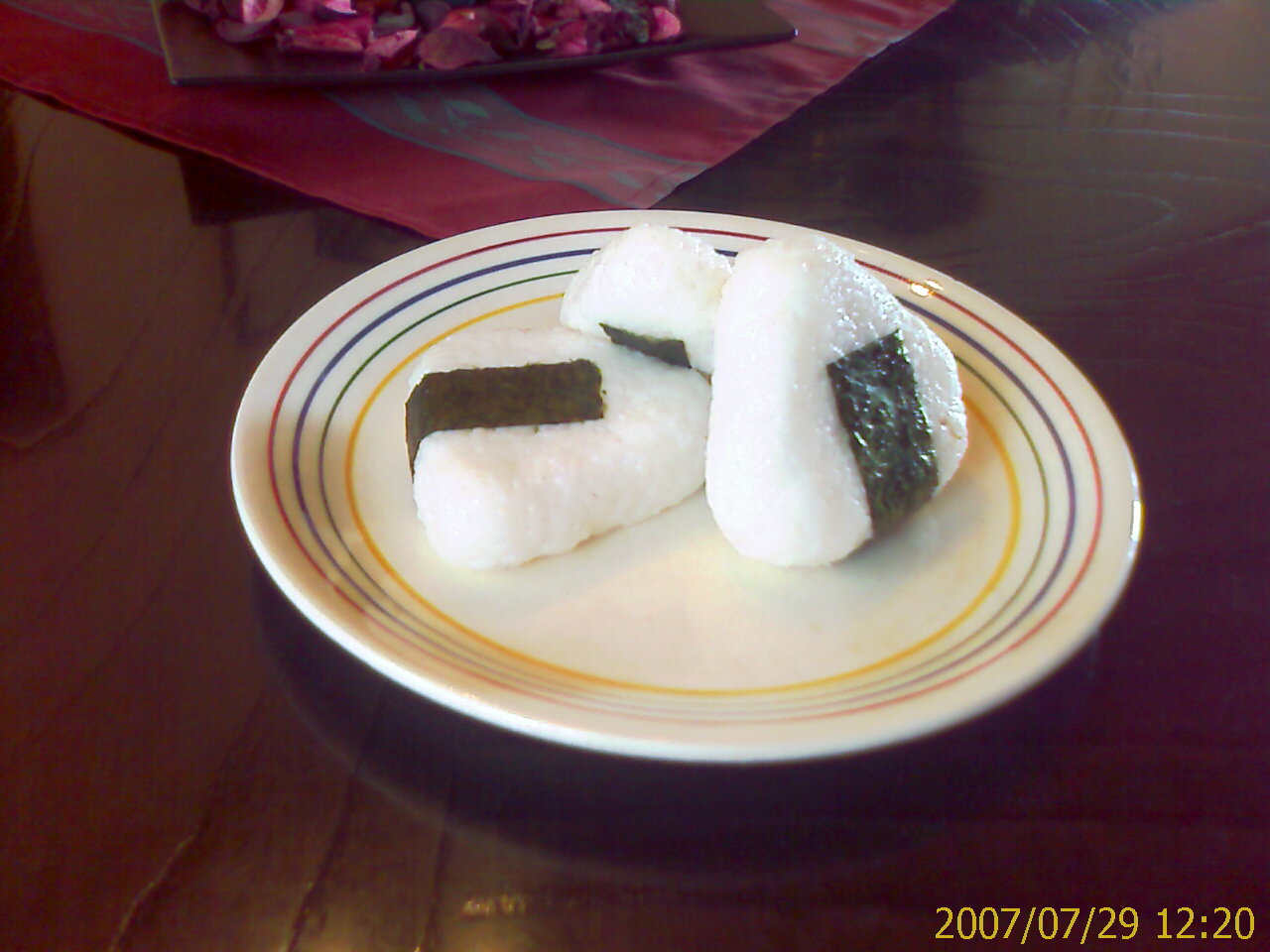
Onigiri - A popular Japanese food item made of white rice clumped into a ball or triangular shape around a fish or other savory or sweet fillings, wrapped with a strip of seaweed. Image from Wikimedia Commons. 
sinnesspiel: (Default)
Chapter Links

Chapter 9 - 1
Chapter 9 - 2
Chapter 9 - 3
Chapter 9 - 4
Chapter 9 - 5
Chapter 9 - 6
Chapter 9 - 7


Anything anyone's curious about, wants me to expand on, linguistic/translation questions, etc.?

We're probably going to have quite a few of these no-note chapters coming up as we've had enough funerals and death to have touched on most things by now.

Profile

sinnesspiel: (Default)
Sinnesspiel

November 2025

S M T W T F S
      1
2345678
9101112131415
16 171819202122
23242526272829
30      

Syndicate

RSS Atom

Style Credit

Expand Cut Tags

No cut tags
Page generated Apr. 2nd, 2026 04:53 pm
Powered by Dreamwidth Studios