
Sinnesspiel (![[personal profile]](https://www.dreamwidth.org/img/silk/identity/user.png) sinnesspiel) wrote2013-11-21 12:44 am
sinnesspiel) wrote2013-11-21 12:44 am
sinnesspiel) wrote2013-11-21 12:44 am


Entry tags:
Shiki Novel Translations 8.0 and notes
Links to Chapter 8
Chapter 8 - 1
Chapter 8 - 2
Chapter 8 - 3
Chapter 8 - 4
Chapter 8 - 5
Chapter 8 - 6
Chapter 8 - 7
Chapter 8 - 8
Chapter 8 Translation Notes
General
Juzu - Prayer Beads used in Japanese Buddhism, their use is similar to a Catholic rosary with beads meant to keep track of counting the sutras while they are chanted. There is also the belief that the good karma leaking off from the chanting of sutras may reside in the juzu. Sutras are typically chanted 108 times as there are believed to be 108 attachments or afflictions that plague man. If more than 108 are to be chanted, some sects start going backwards around the ring of beads to signify breaking the cycle of death and rebirth. The shapes vary between sects as do the appropriate ways of holding them when in use. The formal, larger ones with 108 beads are typically two-ringed, with or without two to four smaller beads dispersed between them. Informal ones may have fewer than 108, are a single ring, and have between 18 and 45 beads usually in some number that divides evenly into 108. Men's informal juzu tend to have larger but fewer beads, women more but smaller. The tassels also come in forms ranging from loose to braided to balled; the tassel style is largely a matter of taste. The appropriate way to hold them between the hands, over one hand, over both, beneath the thumbs, etc. varies by sect.
Examples of men and women's informal juzu from http://www.butsudanya.co.jp.
Examples of holding/use styles by sect from Echo Sekizai.
Chapter 8 - 2
Megumi refers to Natsuno with -sama in her postcard. In formal and very proper letter writing, it isn't uncommon to refer to recipient with -sama even if that would certainly never be used in interactions. This should not be mistaken for a fawning, empty-headed idol worship form of address.
Chapter 8 - 3
Dance of the Straw Coat - A form of torture that involved wrapping a person in a straw coat, as was at times used as a rain coat in the feudal era, and lighting them on fire. It was a form of torture often used on Christians during their persecution in Japan.
Chapter 8 - 5
The flower wreathes and the black and white walls. - Typical scenery at a Japanese funeral. It's not unusual to have the service and all night vigil in the home, particularly in small areas with no funeral parlor or undertaker.
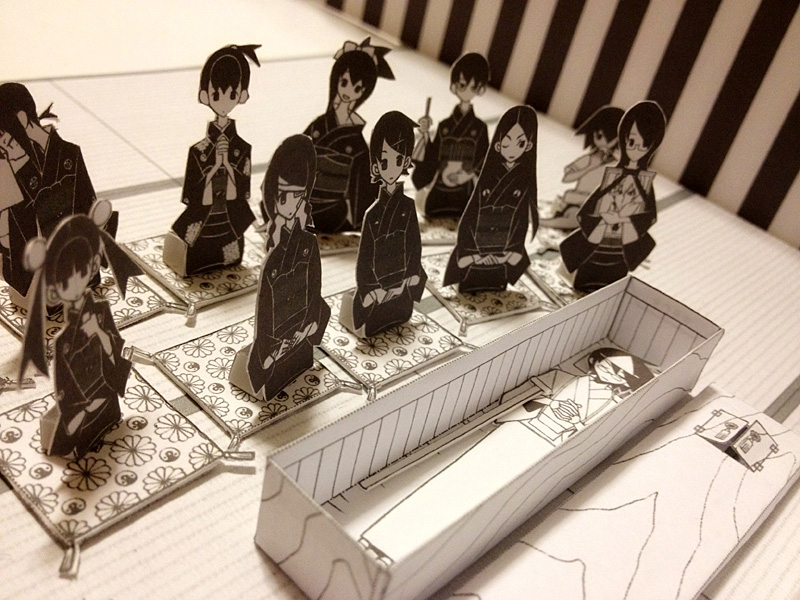
Example of a typical all night vigil/funeral service for Zetsubou Sensei's titular character, in paper craft form. It includes the black and white funeral curtains hung to signify a funeral. Notice the lid is off on the coffin, but that the lid has an opening over the face, to open for those who wish to view it when the lid is in place. Source blog. Has more pictures including the hearse and reception.
Shaved Ice - Popular summer treat similar to a snow cone, ground more finely to the consistency of soft snow and topped with condensed milk as well as the syrup. Example from Wikimedia Commons.
Chapter 8 - 1
Chapter 8 - 2
Chapter 8 - 3
Chapter 8 - 4
Chapter 8 - 5
Chapter 8 - 6
Chapter 8 - 7
Chapter 8 - 8
Chapter 8 Translation Notes
General
Juzu - Prayer Beads used in Japanese Buddhism, their use is similar to a Catholic rosary with beads meant to keep track of counting the sutras while they are chanted. There is also the belief that the good karma leaking off from the chanting of sutras may reside in the juzu. Sutras are typically chanted 108 times as there are believed to be 108 attachments or afflictions that plague man. If more than 108 are to be chanted, some sects start going backwards around the ring of beads to signify breaking the cycle of death and rebirth. The shapes vary between sects as do the appropriate ways of holding them when in use. The formal, larger ones with 108 beads are typically two-ringed, with or without two to four smaller beads dispersed between them. Informal ones may have fewer than 108, are a single ring, and have between 18 and 45 beads usually in some number that divides evenly into 108. Men's informal juzu tend to have larger but fewer beads, women more but smaller. The tassels also come in forms ranging from loose to braided to balled; the tassel style is largely a matter of taste. The appropriate way to hold them between the hands, over one hand, over both, beneath the thumbs, etc. varies by sect.
Examples of men and women's informal juzu from http://www.butsudanya.co.jp.

Examples of holding/use styles by sect from Echo Sekizai.

Chapter 8 - 2
Megumi refers to Natsuno with -sama in her postcard. In formal and very proper letter writing, it isn't uncommon to refer to recipient with -sama even if that would certainly never be used in interactions. This should not be mistaken for a fawning, empty-headed idol worship form of address.
Chapter 8 - 3
Dance of the Straw Coat - A form of torture that involved wrapping a person in a straw coat, as was at times used as a rain coat in the feudal era, and lighting them on fire. It was a form of torture often used on Christians during their persecution in Japan.
Chapter 8 - 5
The flower wreathes and the black and white walls. - Typical scenery at a Japanese funeral. It's not unusual to have the service and all night vigil in the home, particularly in small areas with no funeral parlor or undertaker.
Example of a typical all night vigil/funeral service for Zetsubou Sensei's titular character, in paper craft form. It includes the black and white funeral curtains hung to signify a funeral. Notice the lid is off on the coffin, but that the lid has an opening over the face, to open for those who wish to view it when the lid is in place. Source blog. Has more pictures including the hearse and reception.
Shaved Ice - Popular summer treat similar to a snow cone, ground more finely to the consistency of soft snow and topped with condensed milk as well as the syrup. Example from Wikimedia Commons.
